Surface Mounted vs Recessed Downlight Housings: How to Choose
The decision is usually made for you by the building rather than by preference. Three questions settle it: is there a void, is the ceiling finished, and is the fitting meant to be seen.
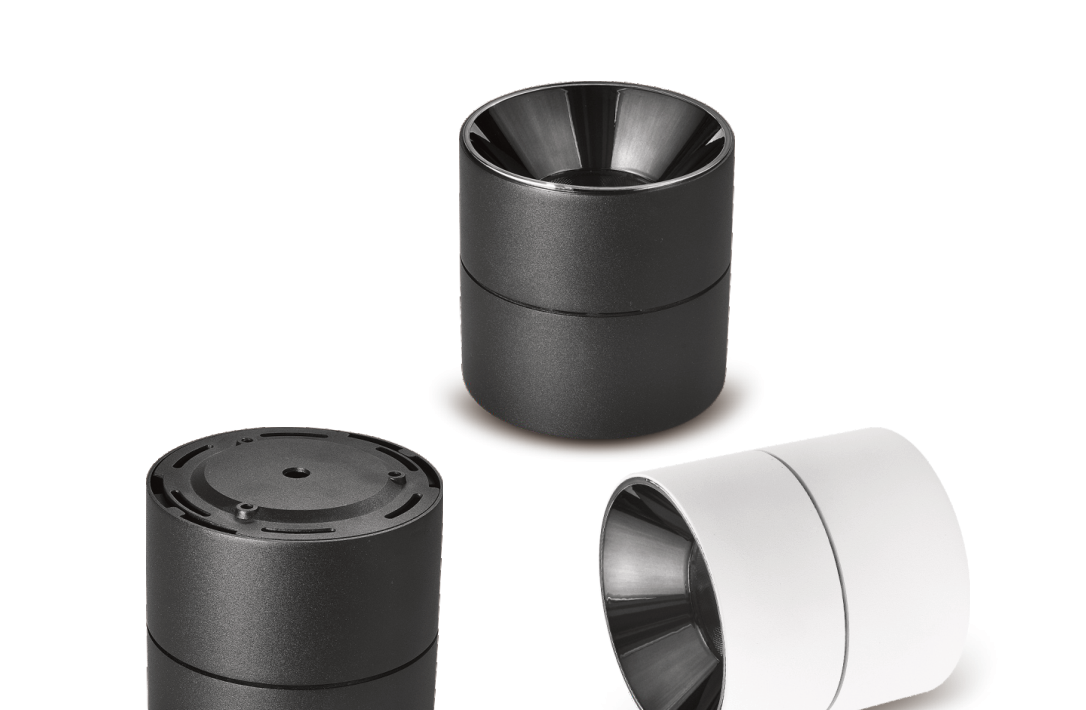
The short answer
A surface mounted downlight housing is used when there is no ceiling void to recess into, when the ceiling is concrete or already finished, or when the fitting is deliberately meant to be visible. It also avoids cutting the ceiling, which matters most in refurbishment. A recessed housing needs a void, a cut-out, and a ceiling that is being worked on anyway.
What recessed does well
Recessed housings put the light source behind the ceiling plane, so the ceiling reads as a clean surface with apertures and nothing else. Where a void exists and a plasterboard ceiling is being installed or replaced, that is the cleaner architectural result, and a trimless version takes it further by hiding the flange above the plasterboard entirely.
The constraints are equally clear: there has to be depth above the ceiling, the cut-out has to be made accurately, and the ceiling has to be capable of being worked on.
What surface mounted does well
- No void required. A concrete slab, a pre-cast floor or a solid ceiling can carry a surface housing where nothing can be recessed into it.
- No cut-out. No dust, no ceiling access panels, no making good afterwards. In an occupied refurbishment this is often the deciding factor on its own.
- Faster installation. The body fixes to the slab or to a bracket rather than into a prepared aperture.
- Visible quality. Seams, coating and diffuser are all on show, which means surface finish consistency becomes part of the specification rather than something hidden above the ceiling.
- Straightforward retrofit. Old surface fittings can be replaced without touching the ceiling structure.
Refurbishment is where the choice actually gets made
On a new-build with a suspended ceiling, recessed is usually the natural answer and the void is free. On a refurbishment with a finished soffit and tenants in the space, a surface housing avoids cutting into a ceiling that has to be reopened and made good — and it avoids doing that work in an occupied building. That single consideration decides a great many projects.
Three questions to settle it
| Question | If yes | If no |
|---|---|---|
| Is there a usable void above the ceiling? | Recessed is available | Surface mounted |
| Is the ceiling finished or concrete? | Surface mounted | Either |
| Is the fitting meant to be seen? | Surface mounted, and the finish becomes the specification | Recessed, or trimless |
What both share on the buying side
Whichever route a project takes, the ordering details are the same: the cut-out or the mounting interface, the wattage and beam, the finish reference, the IP rating demanded by the space, and the destination market. Send those with a drawing or a photo of the existing fitting and the housing can be quoted against them — and where a project mixes both types across floors or areas, they can travel in one shipment.
Frequently asked questions
When should a surface mounted downlight housing be used instead of a recessed one?
A surface mounted housing is used when there is no ceiling void to recess into, when the ceiling is concrete or already finished, or when the fitting is deliberately meant to be visible. It also avoids cutting the ceiling, which matters in refurbishment projects.
What are the advantages of surface mounted housings in a refurbishment?
No cut-out means no dust, no ceiling access panels and no making good afterwards, and the work can be done in an occupied building. The body fixes to the slab or a bracket rather than into a prepared aperture.
Can surface mounted and recessed housings ship together?
Yes. Where a project mixes both types across floors or areas, they can be supplied against the same order and consolidated into one shipment.
Related reading: surface mounted downlight housings, wall washers and trimless downlights.