Lighting Housing MOQ Explained: 100 Pieces, Mixed Sizes, One Container
A minimum order quantity is not a sales threshold; it is the point at which a production run stops losing money. Understanding why it is set where it is makes it much easier to work with — and to get a trial order through it.
Why 100 pieces per size and finish
The minimum on an existing housing series is 100 pieces per size and finish. The unit is not the total order — it is the size and the finish, because those are what change the set-up. A powder line has to be loaded with a colour, and an extrusion or casting line has to be set for a section. Running 40 pieces of a size means the same set-up cost spread over a quarter of the volume.
Framed that way, the number is predictable rather than arbitrary, and it also tells you how to plan around it.
The normal way buyers reach volume: mix sizes
Trial orders are usually placed across two or three sizes rather than betting everything on one model. Three sizes at the minimum is a small, real order that lets a distributor test which one the local market actually pulls, and the answer is often not the one that looked strongest on paper.
Because different sizes can be mixed inside a single container, the trial does not have to justify its own freight. That is usually the difference between a trial that happens and one that keeps being deferred.
One container, several product lines
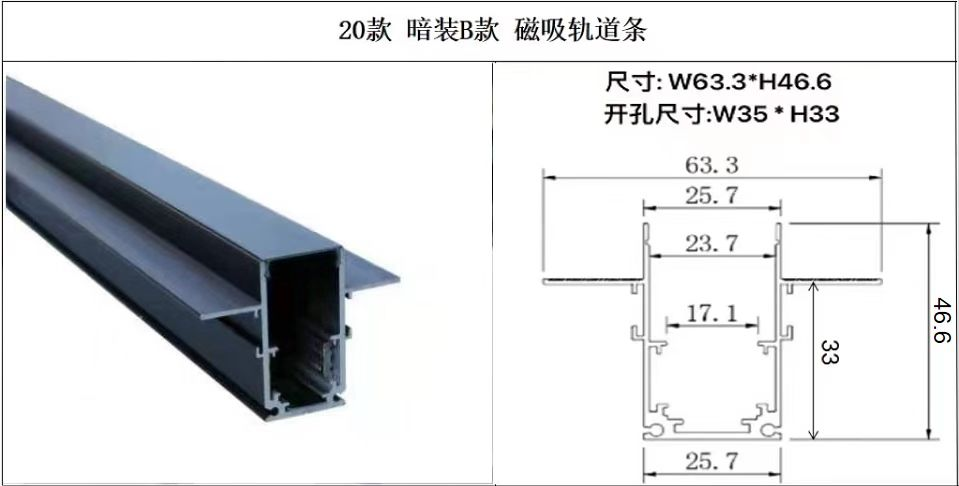
Downlight housings, architectural spotlights, 48V magnetic track, linear aluminium profiles, panel frames and wall washers can be consolidated into one shipment. For a buyer assembling a range, that is the practical advantage: one set of shipping documents and one arrival to plan for, rather than four suppliers, four lead times and four sets of paperwork to reconcile.
This is also the cheapest route to a sensible trial volume, because the container is filled with a range rather than with a single line bought deep enough to justify the freight on its own.
What changes the minimum
- Stocked items. Common surface-mounted body sizes are held in stock, so smaller top-ups are possible than the production minimum would suggest.
- Custom finishes. A non-standard RAL is a separate set-up, so custom colours are usually quoted from a higher quantity than a standard white or black.
- Branding. Laser marking and printed labels add a process step and are typically quoted from 300 pieces upwards on panel and housing ranges.
- New tooling. Where a tool has to be made, the effective minimum is the first production run that makes the tooling worthwhile — and that figure is quoted together with the mould rather than assumed.
Sample quantities before a bulk order
Sample quantities are available ahead of a bulk order, which is how a buyer verifies fit, finish and colour against their own reference before committing. That step is worth taking properly: a sample judged by eye proves that a good part can be made, while a sample measured against the drawing is what actually de-risks the order that follows.
Frequently asked questions
What is the minimum order quantity for lighting housings?
For existing housing series the MOQ is 100 pieces per size and finish. Trial orders are normally placed across two or three sizes rather than one. Custom ODM minimums are quoted together with the tooling rather than assumed.
Can different sizes be mixed in one order?
Yes. Different sizes can be mixed inside one container, which is usually the cheapest route to a sensible trial volume, and several product lines can be consolidated into the same shipment.
What raises the minimum order quantity?
Custom RAL finishes are a separate set-up, and laser marking or printed labels add a process step and are typically quoted from 300 pieces upwards. New tooling sets its own effective minimum, quoted with the mould.
Related reading: the housing ranges and their minimums, qualifying a second source.