LED Profile Diffuser Types Compared: Clear, Frosted, Opal and Prismatic
The diffuser is the smallest part on a linear lighting quotation and the one buyers most often leave to the supplier. It is also the part that decides whether a finished run reads as a continuous line of light or as a row of visible LEDs. This guide sets out what each cover does, what it costs you in output, and the four numbers to fix before you request a price.
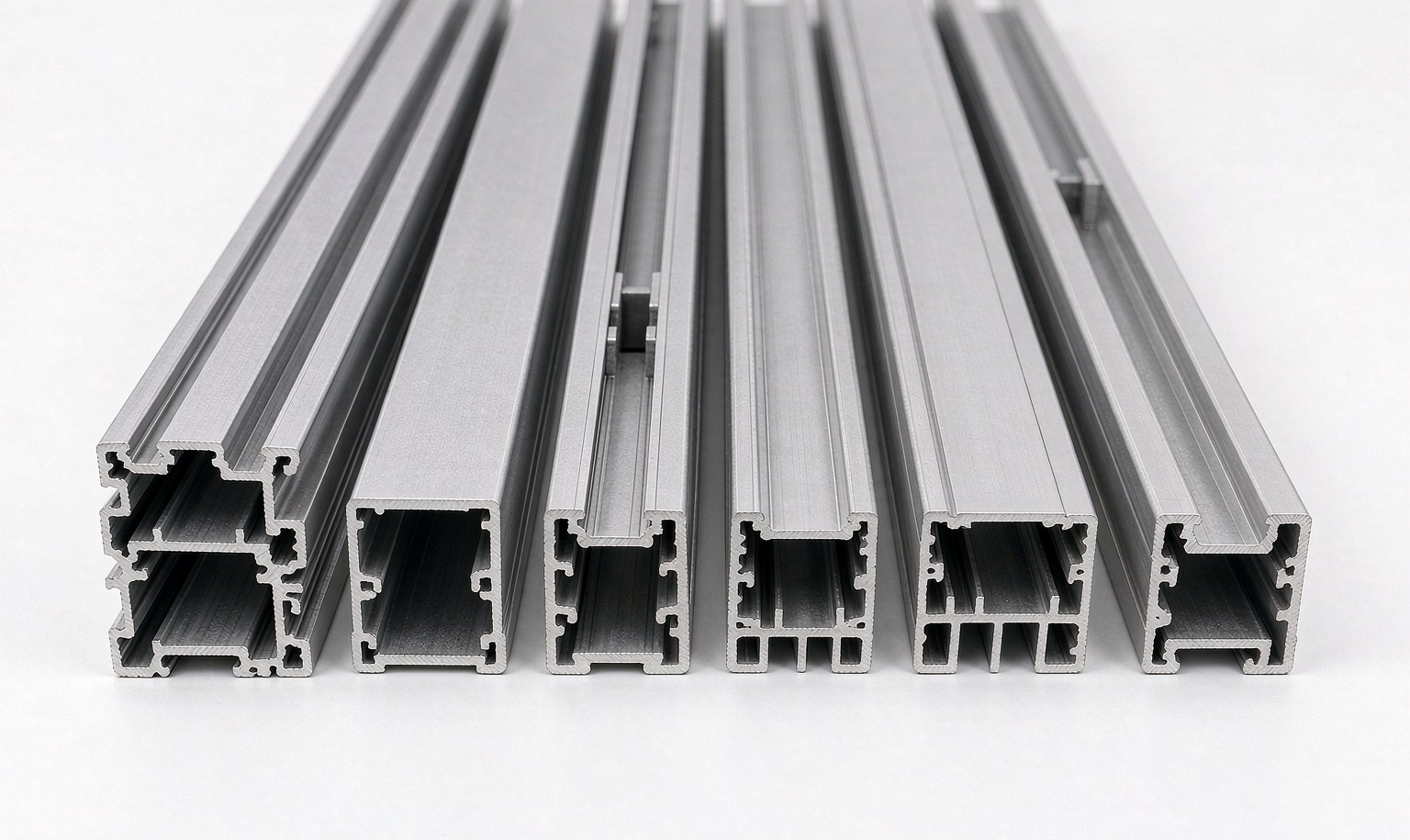
The short answer
There are four cover choices in commercial linear lighting, and each one is a different trade between output, dotting and glare:
- Clear — maximum output, no diffusion, individual LEDs visible. Used where the run is hidden or viewed only indirectly.
- Frosted — the common default. Most dotting disappears, output loss is modest, the line reads as a line at normal viewing distance.
- Opal — heaviest diffusion, the most uniform face, the greatest loss of output. The right choice wherever the run is seen close up.
- Prismatic — a structured cover that spreads light sideways and cuts glare at steep viewing angles. Chosen for glare control rather than for hiding dots.
None of these is better than the others in isolation. The correct answer depends on where the run sits relative to the eye, and on how hard the LEDs are driven.
What a diffuser is actually doing
An LED board is a row of point sources. Between two adjacent emitters there is a dark gap, and at close range the eye resolves that gap as a dot pattern. The diffuser’s job is to spread each emitter’s light far enough sideways that the gaps are filled by light from the emitters either side of them.
That is all diffusion is: scattering. And every scattering event costs light. A cover that spreads widely enough to make a run look completely continuous will always cost more output than a cover that spreads narrowly. This is why quotations that differ only in the diffuser can differ measurably in delivered lumens on the same board and the same driver.
Two further effects are worth knowing before you specify:
- Pitch matters more than diffuser. A widely spaced board will dot under any cover short of a very heavy opal. If you want a clean line, the first lever is the emitter pitch and the distance from board to cover, not the type of cover.
- Distance matters. The further the cover sits from the board, the more the light from adjacent emitters overlaps before it leaves the profile. A deeper channel mixes better with a cheaper cover.
Comparing the four cover types
The table below sets out how the four options behave on a typical linear run. Figures are relative, not absolute: the actual numbers depend on board pitch, drive current and how far the cover sits from the board.
| Cover type | Dotting | Output | Glare at close range | Typical application |
|---|---|---|---|---|
| Clear | Visible at close range | Highest of the four | Highest | Cove and hidden runs, in-ground fittings, indirect washes |
| Frosted | Largely resolved at normal viewing distance | Modest loss against clear | Moderate | General linear runs, cabinet and shelf strips |
| Opal | Uniform face, dots not resolvable | Greatest loss of the four | Lowest | Office lines seen from below, retail, low ceilings |
| Prismatic | Depends on prism pitch | Between frosted and opal | Low at steep angles, controlled in a band | Workstation lines where a glare figure such as UGR must be held |
Two consequences follow from the table. First, where dotting and output are both critical, the answer is almost never to add more diffusion — it is to reduce the emitter pitch or deepen the channel, because both improve mixing without scattering light out of the useful beam. Second, a prismatic cover is not a substitute for an opal cover: it redistributes light, so a badly dotted board under a prismatic cover is still a badly dotted board.
Matching the cover to the profile channel
The diffuser is a fit part, so it is constrained by the profile it clips into. The width of the PCB channel is the governing number: the cover must span the channel and hold the board in place without pressing on the solder joints. In our own range the relationship between channel and board width is the one buyers most often get wrong, so it is worth stating in full.
| Application | Die examples | Cross-section (W×H mm) | Matching PCB width |
|---|---|---|---|
| Cabinet & shelf strips | TX-011, TX-079, TX-078 | 8×9 / 10×8 / 8×7 | 6 / 5 / 5 mm |
| Display & cove | TX-012, XK-037B, TX-009, TX-010 | 13×9 / 10×10 / 10×13 / 16×13 | 5–8 mm |
| Office main lines | TX-1210, TX-1212, TX-142, TX-143 | 12×10 / 12×12 / 17.5×7 / 24.5×7 | 8–12 mm |
| General linear runs | TX-026, TX-029, TX-128, TX-129, TX-043 | 22×14.5 / 17×12 / 14.5×9 / 21×9 / 14×8.8 | 12 mm |
| Suspended office pendants | TX-140, TX-041, TX-059, TX-040 | 30×20 / 20×15 / 25×15 / 30×30 | 17–28 mm |
| High-output lines | TX-014, TX-015, TX-016, TX-013 | 50×20 / 65×25 / 50×25 / 65×20 | 47 mm |
The pattern is straightforward: a cover sized for an 8 mm board will not clip over a 12 mm channel, and a channel wide enough for a 47 mm high-output board carries so much emitter area that an opal cover is doing very little hiding work. Read the channel width first, then choose the cover, then confirm the board pitch is tight enough for the uniformity you need.
The four numbers to fix before you request a quotation
Most diffuser arguments at sample stage are the result of leaving these undecided in the enquiry. Fix them and the quotation becomes comparable line for line.
- Cross-section and channel width. Width × height of the extrusion, and the internal channel width the cover has to span. Without this, a supplier is quoting a shape rather than a part.
- Viewing distance and angle. How far from the eye the run will sit, and whether it is seen face-on or at a glancing angle. This single number drives the choice between frosted and opal more than any other.
- Emitter pitch and drive current. Pitch in millimetres and the current the board will run at, or the target output per metre. Pitch is the real control on dotting; current is the real control on whether the cover discolours over time.
- Length regime and tolerance. Maximum single length, how runs are joined, and the cut tolerance the site can absorb. A cover mated across a joint needs a stated tolerance, or the run will show a shadow line at every junction.
Where this goes wrong in practice
Three failure modes recur often enough to be worth naming.
- Specifying opal to fix a pitch problem. Heavy diffusion hides dots at the cost of output. If the real issue is a 30 mm emitter pitch on a 30 mm channel, the fix is the board, not the cover. Choosing opal instead means paying twice — once in lost lumens, and again when the customer still complains.
- Mixing batches of covers across a run. Two production batches of the same nominal opal material can differ in how much light they scatter. Over a long continuous run that reads as a visible step where the material changes. Where a project uses one run of 60 metres, the covers for the whole run should come from one batch, and the supplier should be asked to state that on the quotation.
- Assuming the cover is UV-stable because it is plastic. A cover over a high-output board is exposed to heat and to the short-wavelength output of the emitters. Both degrade some materials over time, which shows as yellowing and a shift in the appearance of the line. Where a run sits in a ceiling void with poor airflow, ask how the material behaves at the operating temperature rather than at room temperature.
How to compare two quotations that differ on the diffuser
When two suppliers quote the same cross-section at different prices and the delta is in the cover, ask for the same four facts from each: the material designation of the cover, the wall thickness at the clip, the stated light transmission of that specific cover, and the batch handling policy for a project run. A supplier who can answer all four is quoting a part. A supplier who answers with a colour adjective is quoting a price.
The practical test at sample stage is simple: request one metre of the run as a mock-up, mounted at the real viewing distance and with the board at the real pitch and current, and compare it against the drawing rather than against a catalogue photo. That one metre of sample tells you more about the diffuser than any datasheet.
Frequently asked questions
Which diffuser gives the most light output?
A clear cover transmits the most light because it does not scatter the beam, but it shows individual LEDs. A frosted cover scatters the light and removes most dotting at a modest loss. An opal cover diffuses hardest, produces a uniform line, and costs the most output. Prismatic covers sit between frosted and opal and are usually chosen to control glare rather than to hide dots.
Can I swap from clear to opal on the same profile?
Yes, where the cover is a separate part rather than co-extruded with the body. The channel geometry stays the same, so the same profile can carry a clear, frosted or opal cover. What you cannot change this way is the channel width, so a board that was already tight in the channel stays tight.
Does the diffuser change the colour temperature?
It does not change what the LEDs emit, but it changes what the eye receives. Opal and prismatic covers scatter light from adjacent LEDs so the colour mixes better, which is why a run of mixed-bin LEDs looks more even under an opal cover than under a clear one. This is also why colour consistency is worth fixing at the LED purchase stage, not at the diffuser.
What diffuser should I use in a kitchen or a low ceiling?
Where a linear run sits within about two metres of the eye, glare from the bare LEDs dominates and an opal cover is usually the right starting point. On a high ceiling or a cove run seen only indirectly, a frosted cover is normally enough, and it costs less light.
Related reading: linear aluminium profiles and matching PCB widths, Glory Series linear lights with UGR≤16 optics.