Magnetic Track Lighting Specification Guide (48 V, 22 × 25 mm)
Magnetic track is sold as a system, but it is specified as a set of numbers. Get the numbers onto the drawing before you ask for a price and the quotation, the ceiling detail and the electrical load all agree with each other. Leave them out and you find out at fit-out, when the electrician has already cut the plaster. This guide collects the section, the luminaire footprints, the power bands and the callouts that a 48 V magnetic track drawing should carry.
Start with the section, not the luminaire
Almost every magnetic track enquiry starts with the light — the flood, the spot, the grille — and works backwards. It is more reliable the other way round. The track section is the fixed thing: it is cut into the ceiling and it determines what everything else can clip onto.
| System parameter | Value |
|---|---|
| Track cross-section | W 22 mm × H 25 mm — one profile for all three luminaire families |
| System voltage | 48 V DC (magnetic, tool-free luminaire retention) |
| Colour rendering | CRI 80–90 across the range |
| Colour temperature | 3000 K / 4000 K / 6000 K |
| Luminaire power band | 6 W to 40 W per luminaire |
Because the section is shared, luminaires can be re-aimed, added or swapped without touching the ceiling. That is the entire commercial argument for magnetic track, and it is worth stating on the drawing so the client understands what they are paying for.
The three luminaire families and their footprints
A magnetic track system is only as flexible as the range of bodies that fit it. The standard range splits three ways, and each family has its own relationship between length and power.
| Family | Power / length options | Body |
|---|---|---|
| Flood light | 10 W / 15 W / 20 W / 30 W / 40 W | L 300 / 450 / 600 / 900 / 1200 mm × W 22 × H 25 mm |
| Grille light | 6 W / 12 W / 18 W / 24 W | L 112 / 220 / 328 / 436 mm × W 22 × H 25 mm |
| Rocket track spot | 7 W / 10 W / 15 W / 20 W | φ35×L80 / φ45×L100 / φ55×L115 / φ65×L135 mm |
Two things fall out of that table and are worth noting on any drawing. First, the flood and grille bodies run on the track axis, so long floods along a run define the visual rhythm of the ceiling — aim for even spacing that divides the run length cleanly. Second, the rocket spots are the only family that also comes as a recessed version, which introduces a separate ceiling cut-out (see below).
Recessed, surface or suspended — decide before the plaster
The mounting method changes the ceiling detail far more than it changes the track. All three options use the same 22 × 25 mm profile, but they land in the building differently.
| Mounting | Ceiling requirement | Where it suits |
|---|---|---|
| Recessed (plaster-in) | A continuous channel and, typically, a trimless frame set flush; needs depth and plastering access ahead of time | New ceilings, architectural schemes where the track should disappear |
| Surface-mounted | Clips fixed to a finished ceiling; no channel required | Refurbishments and existing ceilings |
| Suspended | Cable suspension kits from a slab or soffit | Double-height retail, high voids, temporary structures |
The recessed option is the one that punishes late decisions. Once the plasterboard is up and skimmed, a trimless detail is no longer a lighting decision — it is a building repair. If your client wants the track to vanish, that call belongs on the first ceiling drawing, not in a variation.
Signing off the recessed rocket box
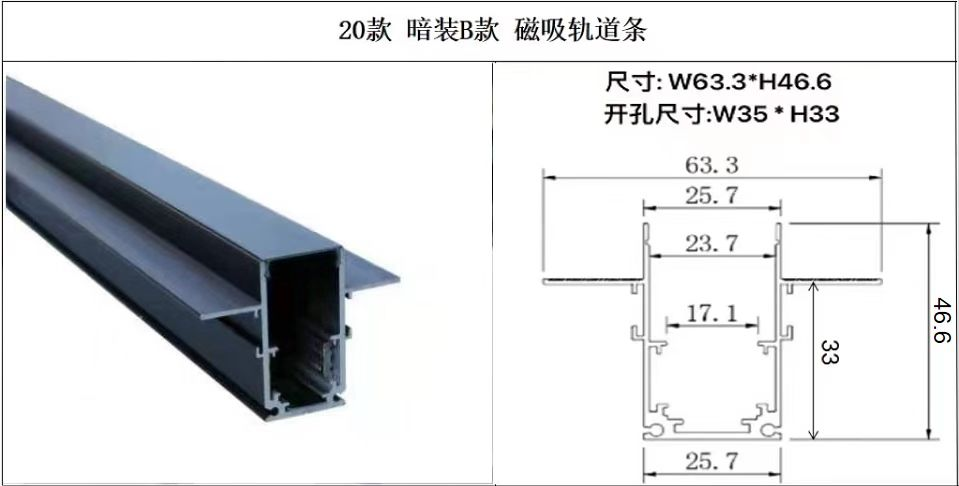
The rocket spot has a recessed variant for aimed accent lighting where the body should sit into the ceiling. It needs its own rectangular cut-out, and the two sets of numbers are easy to confuse: the body is round, and the recessed box around it is not.
| Dimension | Value |
|---|---|
| Recessed box body | W 63.3 mm × H 46.6 mm |
| Ceiling cut-out | W 35 mm × H 33 mm (rectangular) |
Because the cut-out is rectangular and close to the track, the sequence of trades matters: the box is positioned and the cut-out is formed while the track channel is being set, not after. Put the box dimensions and the cut-out on the drawing next to the track run, so the fitter is working from one sheet.
The five numbers to fix before you request a quotation
Almost every magnetic track question can be answered once these five are settled. Supply them in one message and the quotation is accurate the first time.
- Run length in metres, per track run, including whether runs are continuous or broken.
- Luminaire mix and count — how many floods, grilles and rockets, and at which power, per run.
- Connected load in watts per run, and the number and location of power feeds.
- Connector count — straight, L, T and X — plus one end cap per exposed run end.
- Mounting method — recessed, surface or suspended — and the finish (for example black, white or a specified RAL).
Feeds deserve a note of their own. On a 48 V system the number and position of power feeds is a layout decision, not an afterthought: a long run fed from one end is electrically different from the same run fed at both ends, and the answer depends on your total load and the run length. Fix the load first, then let the supplier confirm how many feeds the run needs.
Interface and tolerance callouts worth writing down
Most magnetic track failures are not failures of the track. They are failures of the interfaces around it — the adapter that did not quite fit, the run that was not quite straight, the coating that did not quite match. Five callouts cover them.
- The section, with a revision. Ask for the section drawing and note its revision. The 22 × 25 mm interface is a mainstream one, but fitment of third-party adapters should be confirmed against the actual profile before you commit to a mixed-brand layout.
- Straightness of long runs. A slight bow that is invisible over two metres can be obvious over a ten-metre run in a gallery. Agree how straightness is checked and over what length with your supplier, and if a run is very long, consider a soft joint or a break.
- Cut-out tolerance on the recessed box. The rectangular cut-out is set by hand before plastering; agree the cut-out dimension and the plaster-line margin with your supplier so the trim or box sits flush rather than proud.
- Finish and colour batch consistency. Order the whole run's track and all its luminaires together where you can, and ask for a retained sample from the approved batch, so later additions match the ceiling as installed.
- Continuity across connectors. Every joint is a place where a contact can fail. Ask how connector continuity is checked before packing, and keep one spare connector of each type on site.
None of these requires you to hold a tolerance figure in your head. They require you to ask, in writing, and to note the answer on the drawing revision. That is the difference between a system that flexes with the client and one that has to be rebuilt when the layout changes.
Where magnetic track earns its cost
Magnetic track is not the cheapest way to light a ceiling. It pays for itself where the layout is expected to change after handover, or where the client values being able to change it.
- Retail and fashion. Floods for ambient wash, rockets for merchandise accents — one track, two jobs, re-aimed between seasons without an electrician.
- Galleries and showrooms. Grille and rocket optics aimed at exhibits, rearranged between exhibitions while the ceiling stays untouched.
- Offices and hospitality. Continuous flood runs along circulation with spot accents over seating and display.
Where the layout is fixed for the life of the installation and nothing will move, a conventional fixed downlight is usually the cheaper answer, and it is worth saying so rather than selling track into a ceiling that will never use it.
Where JUNKE fits
JUNKE Global is a Shanghai-based supplier and exporter of commercial lighting housings, reflectors and profiles. For magnetic track we supply the 22 × 25 mm profile by the metre, the connectors and end caps, and the flood, grille and rocket luminaires that clip onto it — as components for assemblers who fit their own LED and driver supply, or as complete luminaires. Trial orders can combine a short track run with a mixed luminaire carton, so a showroom mock-up does not need a container behind it.
If you are still setting the section, our magnetic track system page carries the full system facts and the luminaire specification table, and the OEM / ODM page shows how a custom track or luminaire variant runs from drawing to first article. Send the run length, luminaire mix, load and mounting method, and we reply with a quotation and lead time.
Frequently asked questions
What is the cross-section of a magnetic track profile?
The mainstream 48 V magnetic track section is 22 mm wide by 25 mm high. Every luminaire family in the system — flood, grille and rocket — clips onto that same profile, and the same section is used for recessed, surface-mounted and suspended installations. Confirm the section drawing revision with your supplier before you commit a ceiling detail.
How much magnetic track do I need to specify?
Fix the run length in metres first, then the luminaire mix and count, then the connected load in watts. Add the connector count — straight, L, T and X — and one end cap per run end, then decide where the power feed lands. Quoting from a luminaire list alone is the most common cause of a short shipment once the electrician starts fitting.
Can I buy magnetic track profiles without luminaires?
Yes. Track profiles by the metre, straight and L/T/X connectors, end caps and suspension kits are all supplied separately, which suits assemblers who fit their own luminaires onto the track. Trial orders can combine a short track run with a mixed luminaire carton; volume terms are discussed from around 500 m per shipment.
Which mounting methods does a magnetic track system support?
Three: recessed (plaster-in, usually with a trimless frame), surface-mounted with clips, and suspended on cables. The mounting choice changes the ceiling detail more than the track itself, so decide it before the plaster goes up — retrofitting a recessed detail into a finished ceiling is the expensive mistake.
Related reading: six checks for qualifying a housing supplier, and the downlight cut-out and trim size reference.